Monday, November 6, 2023

Photo III - Project II: Projection and Franz Kafka’s The Metamorphosis

 Franz Kafka (1883-1924) was a German-speaking Jewish novelist and short story author based in Prague, Germany. Kafka is best known for his novels The Trail and The Metamorphosis.

Kafka’s works involve mixing the fantastical with the everyday, allowing pathological delusions to take hold in reality. He explores themes of alienation, existential anxiety, guilt, and absurdity. A shift from this state of normalcy to one of complete desolation is also common.

In his renowned novella The Metamorphosis (1915), Kafka tells a story of a man (named Gregor) who suddenly wakes up as a (human-sized) beetle. The book details how the man copes with the situation and (more so) how his family reacts to his transformation. At it’s core, The Metamorphosis explores the degradation and transformative power of alienation. Throughout the novella the dynamic between family members (particularity Gregor and his sister and father) is focused on through the lens of his families frustration, disgust, and lastly relief (due to Gregory’s seemingly inevitable death) regarding the giant beetle that they are now tasked with taking care of - a role that Gregor used to play for them. In summary, The Metamorphosis is an allegory for how a family reacts/copes with a loved one becoming a “useless”  member of society. 

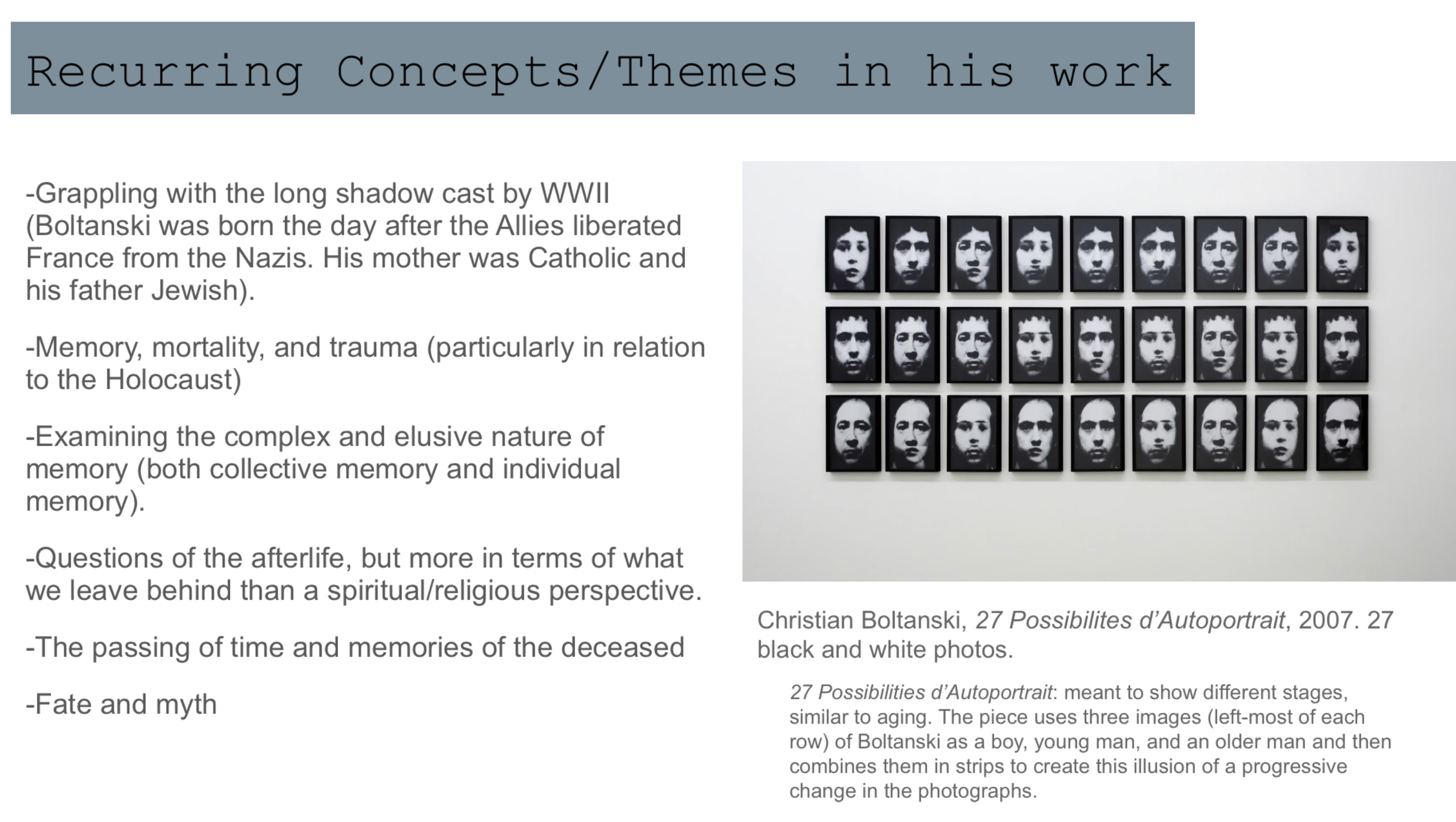
For my projection project I was firstly inspired by the work of Christian Boltanski. As such, I decided to use the most basic form of projection for my assignment - just light and shadow. I decided to depict Gregor’s transformation in Kafka’s The Metamorphosis because of my own interest in the novel as well and because of my current interest (what I am also exploring in senior studio) of human-animal relationships in art. 

My first idea for how to depict Gregor’s transformation was to have two lights from different angles projection two shadows onto connecting walls - one shadow of the beetle and the other of the man. However, when constructing the shape to create these shadows I realized that the spinning motion that occurs because of how the piece hangs was more interesting. Because of this I decided to use just one light and naturally spin the work in front of it - involving the element of performance and through this bringing action to the act of transformation itself.




Thursday, October 5, 2023

Grete Stern

 Grete Stern (1904 - 1999) was a German-Argentine photographer (worked in Argentina, born in Germany) who helped modernize the visual arts in Argentina.

-Studied in Europe at the Bauhaus School where she met and later married married the Argentine photographer Horacio Coppola. When the Nazi party began to gain power in Germany the couple left for London and then Argentina.

-portraiture and collage. Approaching the typical photographic subjects in unconventional ways. 

Dream No. 7: Who Will She Be?, 1949. Photomontage.

Dream No. 1: Electrical Appliances for the Home, 1949. Photomontage.

Hat and Gloves, 1930. 

Autorretrato (Self Portrait), 1943.

Ilse Bing

 Ilse Bing (1899-1998) was a German Avante-Garde artist and commerical photographer. Bing produced her most well-known work during the interwar era. 

-Bing’s photgraphic style was dubbed “documentary humanism”. 

-In 1959, Bing stated that she “had said all that she had to say with photography” and thereafter chose to focus on drawing and poetry. 

“Her friendship with figures associated with the Bauhaus, including the architect Martin Stam and the photographer Florence Henri, as well as her acquaintance with André Kertész in Paris, encouraged her tendency toward the formalist techniques of modernist photography. Like László Moholy-Nagy, the self taught Bing turned her photographs upside-down and sideways to assess their compositional relationships; like Kurt Schwitters, she was attracted to the banal details of urban living--torn tram tickets, gate latches, and other apparently minor objects.”

       - International Centre of Photography

“I felt that the camera grew an extension of my eyes and moved with me.”

-Isle Bing, (quote pulled from MOMA article on her).

Laundry, Frankfurt, 1929. Gelatin silver print.

Self-Portrait in Mirrors, 1931. Gelatin silver print.

French Cancan, Moulin Rouge, Paris, 1931. Gelatin silver print. 

Germaine Krull

 Germaine Krull (1897-1985) was a Dutch-German photographer and a pioneer of the avante-garde art movement, photomontage, the photographic book, and photojournalism. 

-Krull was part of the Neue Frau (New woman): a feminist ideal that emerged in the late 1800s with influence far into the 1900s. The term was used initially by writer Sarah Grand to describe independent women seeking radical change, later evolving as a general term for the feminist and independent woman. 

Germaine worked as a photographer for the French magazine VU, capturing images from infrastructure to intimate portraits.


The Hands of Actress Jenny Burnay, c.1930. Gelatin silver print.

Untitled, 1923-24. Gelatin silver print.

Advertisement for fashion designer Paul Poiret. 1926. Gelatin silver print, 8 5/8 by 6 1/4 inches.

Sunday, October 1, 2023

Iness Rychlik

 Iness Rychlik is a Polish-born artist based in the UK. Rychlik uses her skin condition to imprint patterns/writing/drawings into her skin for her photography. Her art is centred around self-portraits which explore themes of pain, solitude, and vulnerability. Alongside her photographic practice Rychlik has also directed several short films. 

Iness Rychlik, Crooked Little House (2023)

Iness Rychlik, Beyond Repair (2023)

Iness Rychlik, Crumbs (2022)

Thursday, September 28, 2023

Photo III - Project 1: Response to Persona

     For my “Response to Persona” project I chose to focus on the main scene that makes you question whether Elisabeth and Alma are different people or the same person. The repeated speech they each give about the restraints and expectations of motherhood and “motherness” as well as the splitting image of their faces together are what stuck with me most from the film. I decided to focus on the “split face” moment in Persona - but instead of splitting the image down the middle I decided to combination print the portraits over each other to create a sort of “hybrid face”. 

The photos are lined up to merge towards the middle 50/50 split of their faces, moving from a seperate portrait, to the other individual entering the frame, to a 75/25 split portrait, and finally the halfway split of their faces (and then back again in reverse for the other model). I also contrasted my models by having one wear white and the other black, white the white-based model posed against a dark background and the black-based model posed against a light background.

Here is the speech from the movie that I am referring to, as although it didn’t directly influence this work I think there is a lot that I may potentially pull from it in my work later on:


A party, wasn't it? It was late and rather noisy. In the early hours, someone said to you… "Elisabet, you have everything as a woman and as an artist...but you lack motherliness…”

“You laughed because you thought it was ridiculous...but you couldn't stop thinking about what he had said. You grew more worried... so you let your husband make you pregnant. You wanted to be a mother. When you knew it was definite, you became afraid... afraid of responsibility, afraid of being tied down, afraid to leave the theater... afraid of pain, afraid of dying, afraid of your swelling body. But all the time you acted, played the part of the happy expectant mother. And everybody said, "She has never been this beautiful." You tried several times to get rid of the fetus. But you failed. When you knew it was inevitable you started to hate the child...and wished it would be stillborn. You wished that the baby would be dead. You wanted a dead child. It was a long and difficult delivery. You suffered for days. The baby was delivered with forceps. You looked with disgust at your screaming child and whispered, "Can't you die soon? Can't you die?" The boy screamed day and night, and you hated him. You were afraid. You felt guilty. In the end, relatives and a nanny took care of the boy... and you could leave your sickbed and return to the theater. But the suffering was not over. The boy was seized by a massive and unfathomable love for his mother. You resisted desperately because you felt that you could not return it. You try and try...but the meetings with him are cruel and awkward. You can't do it. You're cold and indifferent. And he looks at you. He loves you, and he's soft, and you want to hit him for not leaving you alone. You think he's repulsive, with his thick lips and ugly body and his moist and pleading eyes. You think he's repulsive, and you're afraid. No. I'm not like you. I don't feel the same as you.”

-the photos were taken with my 35mm camera (Fujica St-801) with Kodak 400TX film. I took them in the lightroom using studio lights and my camera’s flash. 


Wednesday, September 20, 2023

Feminist Avantegarde: Art of the 1970s

Exhibition (past): https://thephotographersgallery.org.uk/whats-on/feminist-avant-garde

-this exhibition consisted of 48 artists (including names such as Martha Rosler and Francesca Woodman) and over 150 works from the Verbund collection, which is responsible for this international touring of said body of work. Lesser-known artists included in the show include the poet, actress, and performance artists Katalin Ladik and the Austrian artist Birgitta Jürgenssen. 

This “exhibition highlights groundbreaking practices that shaped the feminist art movement and provides a timely reminder of the wide impact of a generation of artists.” The art exhibited as part of Feminist Avante-garde of the 1970s: Works from the Verbund collection consisted of photographs, performances, video art, and collage, and “reflects a moment during which practices of emancipation, gender equality, and civil rights protest movements became part of public discourse. [The exhibition] operates across public and personal realms - as well as used [the artists body] as central motifs - [through which] these artists sought to address broad political issues and confront patriarchy and sexism in art. In doing so they created new, positively assertive female identities.”

The publication:https://www.amazon.ca/Feminist-Avant-Garde-Sammlung-Verbund-Collection/dp/3791354469

-The art present in this book is “provocative, radical, poetic, ironic, angry, cynical, and heartfelt.

Francesca Woodman, Several Cloudy Days, Rome, Italy. Silver gelatin print, 1977.

Martha Rosler, Cleaning the Drapes from the series Bringing the War Home: House Beautiful. Photomontage, c. 1967-72.

Monday, September 11, 2023

Photo book Proposal

 For my photo book/final project I want to focus on the transitional space between girlhood and womanhood by exploring but also intersecting traditionally contrasting themes such as innocence and sexuality. The project will employ my own feminist perspective on sexualization of young girls through worryingly youthful beauty trends amongst women. The book in a way will pull from and challenge themes of the lolita (for example, Vladimir Nabokov’s novel Lolita and the (far more troubling) film adaption and various book covers.. while using a rather “coquette” aesthetic in the books execution - that being hyper-feminine. I think this said space itself between girlhood and womanhood can be extremely uncomfortable and unsure, but is something that obviously a number of go through (not exclusive of course to cis-gender individuals). 

The book itself will be more of a collage work of sorts, with lots of inclusions other than traditional print styles, such as photograms, scans of writing, and maybe even painting/drawing. In short, there will be a contrast between the innocence of girlhood and self-empowerment in one’s sexuality as a woman. I think that this contrast may be difficult to pull off correctly (that is without leaning into something that unintentionally may come off as exploitative), but I think it will be a really interesting challenge and is something I am very interesting in exploring. The girl and the grown woman coexist inside of many of us.


Photographers that I will be referencing:

Karin Mack

- The feminist avant-garde of the 1970s

-Austrian post-war artist

-First explored woman’s role as housewife, then moved to work more centered around her own feelings as a woman.


Karin Mack, Zerstörung einer Illusion, 1977.

Sally Mann

-contemporary American photographer

- I will be referring to her series At Twelve: Portraits of Young Women in the creation of my own photobook:
           This series “capture[s] the confusing emotions and developing identities of young girls [and the] expressive printing style lent a dramatic and brooding mood to all of her images”
                       -Museum of Contemporary Photography

-lots of photographs of her children (Immediate Family series) … although I understand the artistic merit behind this work, I will not be including any nude photographs of myself as a child in this work as it is something I am not personally comfortable with. I will however be reusing some film from old family photo albums of my two sisters and I as children.

Sally Mann. Untitled from the “At Twelve” Series, 1983-1985.


Monday, April 10, 2023

my photo wall from Open Studio

prints are all darkroom, 11x14 and smaller.